Workshop Resource
Say It Like
You Mean It
Public Speaking for Real Life
You already have something worth saying. This guide is about learning how to say it — clearly, confidently, and in a way that actually sounds like you.
Before We Begin
Listen First
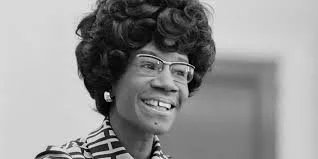
Shirley Chisholm · 1924–2005
Watch · Presidential Campaign Announcement
Shirley
Chisholm
January 25, 1972
The first Black woman elected to Congress. The first Black American and first woman to seek a major party's presidential nomination. She ran because she decided to — and the party, the media, and almost everyone else had told her not to.
What stands out in this speech is how still she is. No anger, no urgency — just someone who already knows she is right and is done explaining it. She won more than 150 delegate votes at the 1972 Democratic National Convention.
What We Just Witnessed
She Didn't Ask
for Permission
Shirley Chisholm was not loud. She did not perform urgency. What made her powerful was something quieter and harder to teach: she spoke as if the outcome had already been decided.
She knew her subject completely. She trusted that knowing it was enough. She did not prepare a polished performance — she spoke from what she knew and from what she demanded.
Being loud is not the same as being powerful. Chisholm was neither. She was just right, and she knew it.
- She was calm because she was clear.
- She didn't argue for her right to be there. She just was there.
- Her preparation served her conviction, not the other way around.
- She spoke to people who doubted her as if they already agreed.
Know Your Why
Confidence Does
the Work
You do not have to have it all figured out. What matters is that you believe what you are saying. When you speak about something you actually know and care about, you are already doing the most important thing. The techniques and the structure come after.
When people hear your why, they hear you.
Think of three people whose voices you trust. What do they have in common? They probably aren't the loudest or the most polished. They are the ones who mean what they say. Conviction is the foundation everything else is built on — not the other way around.
Your Presence
Body Language
& Delivery
Content matters — but so does how grounded your body looks while you're delivering it. Researchers consistently find that nonverbal signals shape trust before a single word lands. The good news is that most of this is learnable.
Posture
Stand with your feet about shoulder-width apart and your weight evenly distributed. This isn't about performing confidence — it's about giving yourself a stable base so your voice has somewhere to come from. Restless shifting signals to your nervous system and your audience that you'd rather be somewhere else.
Eye Contact
Make genuine contact with one person for a full thought before you move to another. Not a quick scan — a real hold. This slows you down in a good way and makes each person feel like they're being spoken to, not at.
Gestures
Let your hands move naturally. Gestures that match your words add clarity. Gestures that don't match are distracting. When in doubt, let your hands rest open and visible rather than clasped behind your back or folded across your body — both read as closed off.
Voice
Vary your pace and pitch. Monotone flattens meaning. Pausing on purpose — after a key point, before a question — signals that what you just said was worth sitting with. Most people rush through their best moments.
Quick Practice
- Record yourself speaking for 60 seconds. Watch it back on mute. What is your body communicating?
- Practice speaking to one point in the room, finishing a complete thought before you move your eyes.
- Read a paragraph out loud, then read it again at half the speed. Notice what the pauses do.
Your Story
Finding Your
Passion
The best speakers are not the ones who talk about things they know — they are the ones who talk about things they feel. Audiences can tell within the first 30 seconds whether you actually care about what you're saying. That signal is almost impossible to fake and almost impossible to miss.
You don't need to be an expert to have a perspective. You need to have lived with it long enough to care.
Finding It
Ask yourself: what do I already talk about when no one is making me? What makes me frustrated or excited in a way I can't quite explain? What do I know that most people in this room don't? Start there.
Connecting It to the Room
Your passion is the starting point, but speaking is a relationship. The best speakers constantly ask: why does this matter to the person listening, not just to me? Your job is to find the bridge between what you care about and what they're trying to understand or solve.
Structure
Strategy &
Structure
A great idea with no structure is just a conversation. Structure is what turns what you know into something someone else can follow. You don't need a rigid framework — but you do need to know, before you open your mouth, what the one thing is you want this person to walk away with.
The Classic Three-Part Move
Tell them what you're going to say. Say it. Tell them what you said. This sounds almost too simple, but it works because it respects how human memory and attention actually function. People need to be primed before they can absorb something, and they need repetition to retain it.
Transitions Are Doing Real Work
The moments between your points matter as much as the points themselves. A weak transition makes two strong ideas feel unrelated. Phrases like "what this means is..." or "here's why that matters..." signal that you're building something, not just listing.
Problem / Solution / Call to Action
What's wrong, how to fix it, what to do next. Good for persuasive and advocacy contexts.
Story / Lesson / Application
What happened, what it meant, how to use it. Good when your credibility lives in your experience.
What / So What / Now What
The fact, why it matters, what you do about it. The most flexible structure and the easiest to internalize.
Planning Tool
Building Your
Outline
Before you write a single word of your actual speech, fill in this structure. Most people skip this step and pay for it later. The outline is where you test whether your argument actually holds — and it's much easier to fix here than after you've already written everything out.
Each point needs evidence — not just an assertion. An assertion is "public speaking matters." Evidence is a story, a number, a quote, or an example that makes someone believe the assertion is actually true.
Practice
Try This Now
Reading about public speaking is not the same as practicing it. The only way to get better is to speak. Here are two exercises to do right now.
Exercise 1: The 2-Minute Argument
Pick a position on something you actually care about. Set a timer for 2 minutes. Speak out loud — to a partner, to yourself in a mirror, to your phone camera — making the strongest case you can. When the timer stops, answer one question: what was the clearest moment, and what was the muddiest?
Exercise 2: The Reframe
Think of a topic you know well. Now explain it to someone who has no background in it at all. The goal is not to simplify — it's to find the entry point, the thing someone already understands that your topic connects to. That skill transfers directly to speaking in any room.
Reflect Afterward
- Did you stay on topic, or did you drift?
- Were there moments where you felt the audience following you? What were you doing then?
- What would you cut if you only had half the time?
Journal Prompts
Reflection
Growth in public speaking rarely feels dramatic. It usually happens in small recognitions — noticing something you did that worked, or understanding why something didn't. These prompts are designed to help you pay attention to that.
- 01What is one thing you said today — in any conversation — that you actually believed? What made it feel different from what you usually say?
- 02Think about a time someone said something that you still remember. What do you think made it stick?
- 03What are you most afraid of when you imagine speaking in front of a group? Is that fear about the audience, about yourself, or about something else?
- 04If you had to deliver one message to the people in this room right now — something you genuinely needed them to hear — what would it be?
Sources
Further Reading
The ideas in this workshop draw on research in communication studies, rhetoric, and performance psychology. These are good starting points if you want to go deeper.
- Chisholm, Shirley. Unbought and Unbossed. Houghton Mifflin, 1970.
- Duarte, Nancy. Resonate: Present Visual Stories that Transform Audiences. Wiley, 2010.
- Mehrabian, Albert. Silent Messages: Implicit Communication of Emotions and Attitudes. Wadsworth, 1971.
- Aristotle. Rhetoric. Translated by W. Rhys Roberts. Dover Publications, 2004.
- Gallo, Carmine. Talk Like TED: The 9 Public-Speaking Secrets of the World's Top Minds. St. Martin's Press, 2014.
- Tannen, Deborah. You Just Don't Understand: Women and Men in Conversation. William Morrow, 1990.
- hooks, bell. Teaching to Transgress: Education as the Practice of Freedom. Routledge, 1994.